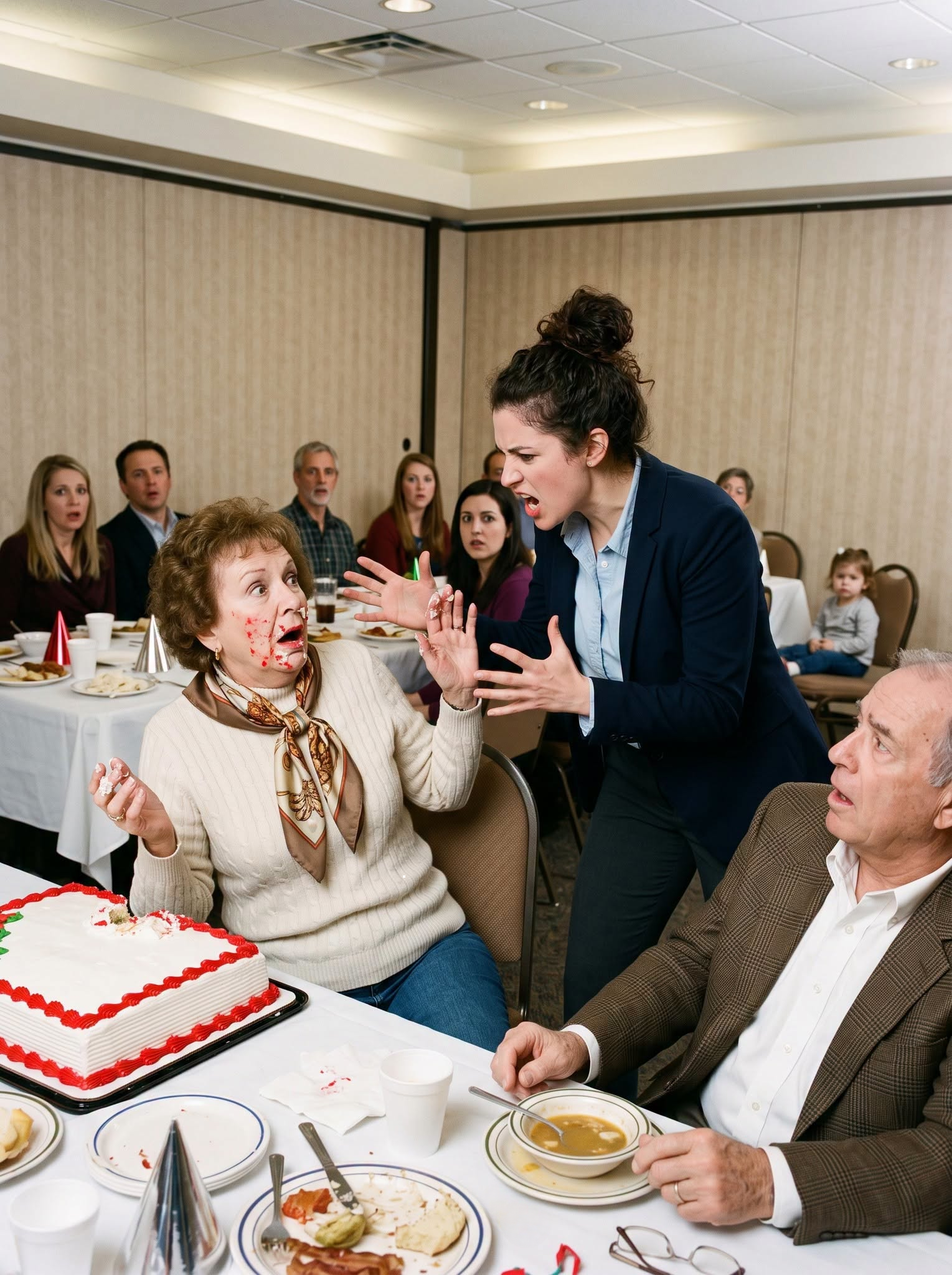
Part 1: The Video My Husband Never Expected Me to See
My mother-in-law slapped my two-year-old daughter during her own birthday celebration, and my husband's first words were not, “Don’t touch her.”
They were, “Mom, I told you—not in front of everyone.”
My daughter had been sitting next to me at the packed family table, irritable and tired after missing her nap. My mother-in-law, Gloria, had spent the afternoon criticizing everything from the food I prepared for Lily to her mispronunciation of certain words, while my husband, Ethan, kept urging me to overlook her and “maintain the peace.”
Then Lily accidentally knocked over a spoon.
Gloria leaned in and called her a cruel name I won’t repeat. Before I could reach over, her hand struck Lily’s cheek.
For a brief moment, the entire room fell silent. Lily looked at Gloria without crying, as if trying to grasp what rule she had violated.
I reacted poorly, and I acknowledge that. I slapped Ethan, pushed Gloria away from Lily, then lifted my daughter out of her chair while relatives shouted around us.
But Ethan did not follow us into the parking lot to check on Lily. He came outside because, in his words, I had humiliated his mother.
I opened the car door and faced him. “Did she hit our daughter?”
He glanced back at the banquet hall, where guests were already gathering around Gloria.
“You know how Mom gets when she’s upset,” he replied.
That was his response. Not an apology, not a vow that Lily would never be left alone with Gloria again, and not a single inquiry about the red mark spreading across his daughter's face.
Lily touched her cheek with two fingers as I secured her in the car seat. “Grandma mad,” she whispered, as if her grandmother’s anger was something she had caused.
I drove to my friend Nora’s apartment since I had nowhere else I felt safe that night. A month earlier, after too many arguments concerning Gloria’s behavior, I had discreetly copied our essential documents, opened an account in my name, and packed a small bag for Lily.
I told myself I was just being cautious. Sitting on Nora’s borrowed bed while Lily slept in an oversized T-shirt, I finally acknowledged that part of me had been waiting for Ethan to make a choice.
Initially, his messages were just as I anticipated. He blamed me for ruining the celebration, embarrassing his family, and frightening the guests.
There were fourteen messages before he even mentioned Lily, and even then, he wrote only: Mom feels terrible about what happened.
He did not inquire whether Lily was okay. He did not ask if I had taken her to see a doctor.
Then Ethan’s cousin, Marissa, sent me a message. She had been recording the birthday candles from across the room.
I’m sorry, she wrote. I think you need the full video.
The clip started before Gloria hit Lily. I saw her grip my daughter’s wrist under the table while Ethan sat beside them, close enough to observe everything.
Then Gloria slapped Lily.
Ethan leaned toward his mother, lowered his voice, and uttered the sentence I couldn’t stop replaying.
“Mom, I told you—not in front of everyone.”
He did not sound shocked.
He sounded annoyed that she had been careless.
I watched the video again, then saved it in three different locations. By the time Ethan called for the sixth time, I realized that leaving the banquet had not marked the end of an argument.
It was the first time I had stopped assisting them in concealing what was happening.
Part 2: The Question the Doctor Asked
The next morning, I took Lily to an urgent-care clinic before responding to another message from Ethan. The doctor examined her cheek, asked if she had lost consciousness or seemed unusually drowsy, and recorded the red mark in her chart.
Then she posed the question I had been evading.
“Has Lily ever seemed afraid around the person who did this?”
I recalled every family dinner where Lily hid behind my legs when Gloria reached for her. I thought of the times she cried when Ethan said Grandma would be babysitting, and the moments he told me I was imagining a problem because toddlers were “moody.”
“I don’t know,” I replied, and hearing the uncertainty in my own voice made me feel nauseous.
The clinic social worker spoke with me privately about filing a report. I showed her Marissa’s video and the messages Ethan had sent overnight, including the ones accusing me of causing a scene while saying nothing about Lily’s condition.
She did not dictate what decision to make regarding my marriage. She helped me document what I knew, preserve the video, and understand that Gloria should not have unsupervised contact with Lily while the situation was assessed.
When we returned to Nora’s apartment, Marissa called. Her voice trembled.
“I should have sent you something sooner,” she said. “I just didn’t know if I was overreacting.”
She forwarded three short clips from previous family gatherings. In one, Gloria yanked Lily away from a toy because she refused to hug her. In another, Lily began to cry when Gloria reached for her plate, and Ethan immediately moved his mother’s hand away from the camera.
The third clip lasted only seven seconds. Gloria was scolding Lily near the hallway while Ethan stood beside her.
“Not that hard,” he murmured.
Gloria looked irritated. “Then teach her to behave.”
The video ended before I could see what happened next, but I didn’t need more footage to recognize the pattern. Ethan had not only failed to act at the banquet; he had spent months trying to keep his mother’s behavior out of view.
I texted him once.
Lily and I are safe. Do not come to Nora’s apartment or contact my friend. Any discussion about Lily will go through my attorney.
His response arrived almost immediately.
You are turning one mistake into a war. Mom said she is sorry.
I stared at the word mistake. Then I turned off my phone and called a family-law attorney recommended by the clinic advocate.
The attorney, Camille Ross, did not promise a dramatic courtroom victory. She advised me to keep communication in writing, gather financial records I could legally access, and avoid posting the videos or discussing the matter online.
“Your strongest point is not whether Gloria is unpleasant,” she said. “It is whether Ethan can prioritize Lily’s safety over protecting his mother.”
By late afternoon, she had filed for temporary orders limiting Gloria’s contact with Lily. The court scheduled a hearing for the following week.
That evening, as I prepared Lily’s dinner, my phone lit up with an email from Ethan. Attached was a scanned form from six months earlier.
It authorized Gloria to collect Lily from daycare, take her to medical appointments, and make emergency decisions if neither parent could be reached.
The signature beneath Ethan’s name was mine.
I had never seen that form before.
Part 3: The Permission I Never Gave
Camille advised me not to accuse Ethan of forgery via text. She asked me to forward the form, preserve the email exactly as received, and contact Lily’s daycare only to request my own parent records.
The director confirmed that Ethan had submitted the authorization form during a routine update six months earlier. He had informed staff I was working double shifts and asked them to accept the paperwork without calling me because he “managed the family calendar.”
The signature resembled mine, but the date was incorrect. I had been out of town at a nursing conference that weekend, and the daycare’s system indicated the form had been uploaded from Ethan’s parent portal after midnight.
The director promptly removed Gloria from the pickup list and flagged Lily’s account so that any attempted changes required direct confirmation from me. She also provided Camille with a record of every instance Gloria had collected Lily.
There were nine pickups I had never been aware of.
On several of those days, Ethan had told me Lily was home with him. In reality, he had arranged for Gloria to take her to her house for hours at a time while I worked late.
I felt foolish for missing it, but Camille stopped me before I could turn that feeling into blame. Ethan had used ordinary details—my shifts, delayed texts, family errands, and the assumption that he was a trustworthy parent—to make the arrangement seem normal.
At the temporary hearing, the judge did not decide the entire marriage or address every allegation. She reviewed the clinic note, Marissa’s videos, the daycare records, and the authorization form, then focused on the one fact Ethan could not explain away.
Gloria had struck Lily in public, and Ethan had reacted by worrying about who witnessed it.
Ethan’s attorney labeled the incident isolated. He stated the family was willing to apologize, attend counseling, and move forward without “unnecessarily restricting” Lily’s relationship with her grandmother.
Camille countered that an apology mattered only after safety. She presented the earlier videos and the undisclosed daycare pickups, explaining that Ethan had repeatedly granted Gloria access to Lily while concealing it from me.
The judge granted temporary orders. Lily would stay with me, Ethan could have supervised parenting time at a neutral center, and Gloria could not contact Lily directly or through relatives until the family assessment was finished.
It was not revenge. It was a short-term decision aimed at giving everyone time to understand whether Lily had been exposed to a pattern of harm.
Outside the courtroom, Ethan finally requested to speak to me. Camille remained nearby, and I agreed only because Lily was absent.
“I didn’t know Mom would hit her,” he said.
“You knew enough to tell her not to do it in front of people.”
His expression tightened. “I meant she gets too intense.”
“That is not an answer.”
For the first time, he looked less angry than frightened. He stated Gloria had always disciplined children harshly, but he thought it was better to keep me from arguing with her because conflict made everything worse.
“You kept Lily from me, too,” I replied.
He had no response.
That night, Marissa sent one last message. While searching her old photos for the court, she had found an audio clip accidentally recorded at a family barbecue four months earlier.
I pressed play.
Gloria’s voice came first. “She keeps telling her mother.”
Then Ethan answered, low and unmistakable.
“Give it time. She’ll learn what not to say.”
Part 4: What Lily Had Been Taught to Hide
Camille asked Marissa to preserve the original audio file and provide a statement explaining how it had been recorded. She cautioned me that one fragment could be challenged in court, but it aligned too closely with the daycare records and Ethan’s own words in the birthday video to ignore.
A child advocate was assigned to Lily’s case. Her role was not to determine who was evil or force Lily to describe adult behavior; she was there to evaluate what Lily needed to feel safe and recommend a parenting plan to the court.
Lily began play therapy with a clinician who specialized in young children. I waited outside during the sessions and did not inquire what she said afterward.
One afternoon, the therapist told me only that Lily had repeatedly used the phrase “Grandma’s rules.” She had said it while arranging toy figures around a small dollhouse.
“What rules?” I asked before I could stop myself.
The therapist shook her head gently. “It’s important that Lily gets to tell her story in her own way. What matters right now is that she has learned some things must be hidden from you.”
That was enough.
Ethan attended his first supervised visit at the family center the following week. He arrived with a bag of toys, a written apology, and a request to speak with Lily alone for “just one minute.”
The supervisor refused. The temporary order required every interaction to remain visible, and Lily did not approach him until he promised that Gloria would not be there.
When he said it, she looked at him carefully.
“Grandma can’t come?” she asked.
“Not today,” Ethan replied.
Lily’s expression changed, not with joy but with relief. She settled beside the toy kitchen and allowed him to join her, but every few minutes she glanced toward the door.
The supervisor documented it all.
After the visit, Ethan called me through Camille. He said he had finally listened to the audio Marissa sent and realized how it sounded.
“It’s not what you think,” he stated.
“Then tell me what you meant.”
He took a long time to respond. Finally, he confessed Gloria had been using a harsh form of discipline when Lily cried, resisted hugs, or asked to come home early. He claimed he had told her to stop several times, but he never removed Lily from her care because he did not want to lose his mother’s help or provoke another family conflict.
“You chose convenience,” I said.
“I thought she would outgrow being scared.”
“She is two, Ethan.”
He began to cry then, but I had reached the point where his regret could not replace the protection Lily had needed earlier. I told him that any relationship he rebuilt with her would have to be based on honesty, patience, and actions supervised by people who understood what she had experienced.
Two days before the follow-up hearing, Camille received a response from Gloria’s attorney. Gloria denied intentionally striking Lily and referred to the recorded incidents as “mischaracterized family discipline.”
Attached was a declaration signed by Ethan.
It stated that he had never seen Gloria frighten or physically harm Lily before the banquet.
Camille placed the document beside the audio transcript and the daycare logs. Then she looked at me quietly.
“He has chosen a position,” she said. “Now the court will have to decide whether he can be trusted to protect her.”
Part 5: The Boundary He Would Not Draw
At the follow-up hearing, the judge did not perceive the case as a contest between a mother and a grandmother. The question was whether Lily had adults around her who could recognize fear, respond to it, and prioritize her safety above the comfort of the family.
Camille presented the birthday video, the earlier clips, the daycare records, and Marissa’s authenticated audio. Ethan’s declaration claimed he had never seen Gloria frighten Lily, but his voice in the recording indicated he knew Lily had been confiding in her mother about something.
Ethan’s attorney contended that he had made a poor decision under pressure from an overbearing parent. The judge did not dispute that he had been influenced by Gloria.
“What concerns the court,” she said, “is that he chose to deny what he knew rather than protect his child from it.”
The temporary plan remained in effect. Lily would live with me, Ethan’s visits would continue under supervision, and Gloria would have no contact with her unless a future court order altered that decision.
The judge also mandated Ethan to complete a parenting program and individual counseling before requesting expanded time. It was not a punishment meant to destroy him; it was a condition aimed at answering a fundamental question he had avoided for too long.
Could he prioritize Lily when his mother disagreed?
Ethan signed the separation agreement three months later. He did not contest the restriction on Gloria’s access, but he still insisted that I had “turned his family against him.”
I ceased trying to make him understand. He had heard the evidence, watched his daughter flinch from the door during visits, and listened to the court explain why his choices mattered.
Understanding was no longer something I could provide for him.
Lily and I moved into a small apartment near Nora. It was not the life I had envisioned when I married Ethan, but it was peaceful, and peace began to feel like a gift rather than a void.
Her therapy continued. Some days she played joyfully and seemed unaffected by the past; on others, she became tense whenever someone raised their voice or reached for her too quickly.
I learned not to demand progress on a timeline. My role was to ensure she knew she could say no, ask for assistance, and never carry an adult’s anger as if it belonged to her.
One rainy afternoon, Lily discovered the birthday dress she had worn the night Gloria struck her. She held it up, looked at me, and asked, “Do I have to wear this again?”
“No,” I replied. “You never have to wear anything that makes you feel bad.”
She contemplated that for a moment, then placed the dress in a donation bag. Afterwards, she chose her yellow raincoat and asked if we could walk to the bakery.
Outside, she held my hand and jumped over every puddle she could find. When a car horn sounded nearby, she flinched, then looked up at me.
“Mommy?”
“I’m here.”
She squeezed my fingers and continued walking.
I still had the video from the banquet, the messages, the clinic note, and every document that followed. They were significant because they helped Lily receive protection when she needed it.
But they were not the part of the story I revisited most frequently.
What lingered with me was the moment I stopped equating silence with peace. I had believed I was preserving a family by avoiding arguments, but a family that asks a child to be afraid in secret is not being preserved.
It is being shielded from the truth.
Lily was too young to articulate everything that had transpired around her. She did not need to.
Her fear had already been communicating.
This time, I listened.