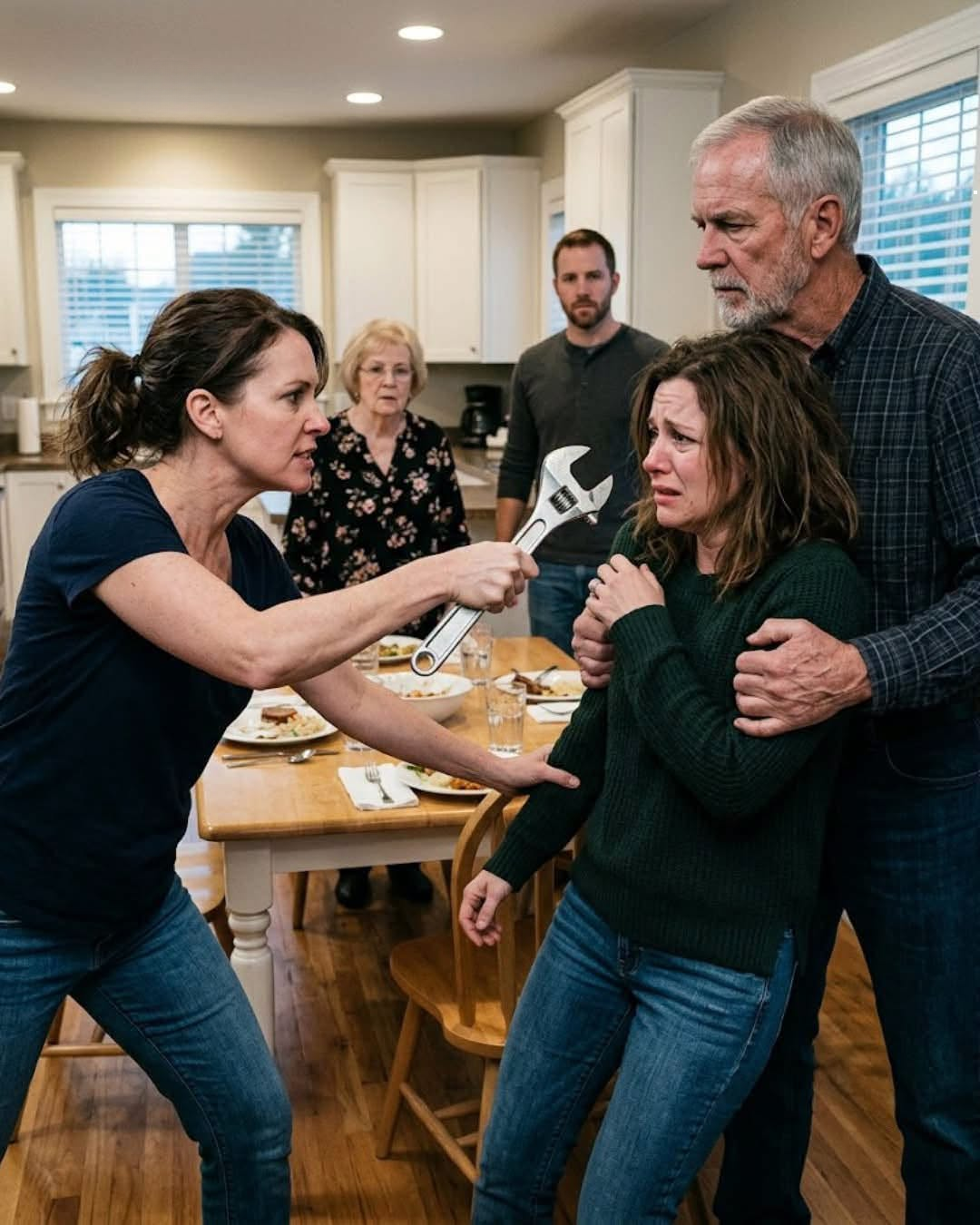
My hand was already on the ajar door when my sister’s boyfriend faced her and declared he would not be departing with her.
For a brief moment, I nearly forgot about the ache in my face.
My sister gazed at him as if he had just violated a secret rule she never thought he would challenge.
My mother shifted her gaze between him and me, clearly attempting to comprehend how a dinner that had been meticulously planned had derailed so drastically.
My father remained close to the table.
Just minutes prior, those same hands had gripped my arms while my sister stood before me wielding a wrench.
Now everyone was suddenly preoccupied with appearances.
My sister stepped closer to her boyfriend.
“You’re really doing this because of her?”
He didn’t respond right away.
That seemed to infuriate her even more.
“You don’t even know her.”
He glanced at me, then at the wrench still dangling loosely from her grasp.
“I know what I witnessed.”
It was such a straightforward statement that nobody appeared ready for it.
They were accustomed to disputes.
They were used to accusations.
They were familiar with my attempts to justify myself until I was too worn out to do anything but apologize just to end the conversation.
What they were not accustomed to was someone outside the family rejecting the narrative they presented.
I clenched the items I had gathered before heading for the door.
My shoulder throbbed from hitting the ground.
One side of my face pulsed where my mother had struck me.
My wrist still bore the imprint of my father’s grip.
Yet the oddest part was how normal the dining room still appeared.
Plates were still on the table.
Food sat cooling under the lights.
A chair was pushed back at an angle from where I had stood.
If someone had walked in without any knowledge of the events, they might have thought we had merely experienced a bad argument over dinner.
That was part of what made the entire situation so unsettling.
My family had treated what occurred as commonplace.
My mother had referred to it as discipline.
My sister had labeled me dramatic.
My father had behaved as if physically preventing me from leaving was simply his authority.
And prior to any of it happening, they had seemingly discussed the likelihood that I might attempt to walk out.
The realization hit harder than I anticipated.
This had not been a chaotic family brawl that spiraled out of control in moments.
At least part of it had been foreseen.
My sister’s boyfriend had arrived before me that evening.
While she was upstairs preparing, he had overheard her conversing with my parents in the kitchen.
At that moment, their dialogue hadn’t made much sense to him.
My sister had told my father that if I caused a scene and tried to leave without apologizing, he should intervene.
That was the detail I kept returning to.
Stop me.
Not calm me down.
Not ask me to stay.
Stop me.
By the time my father seized my arms, he was not conjuring a reaction in the heat of the moment.
He was executing something they had already deliberated.
My sister had responded to that revelation in the worst possible manner.
She hadn’t denied saying it.
She had demanded to know why her boyfriend had been eavesdropping.
I could still hear the question echoing in my mind.
Why were you listening to us?
As if that was the true betrayal.
As though being overheard mattered more than the content of what had been said.
My mother’s voice drew me back into the room.
“This is absurd,” she stated.
She was addressing my sister’s boyfriend now, not me.
“You walked into one family disagreement and suddenly you believe you understand years of history.”
He remained where he was.
“I understand that you struck her with a wrench.”
My mother tensed.
“She was talking back.”
There it was again.
No denial.
No confusion.
No attempt to pretend the strike had never occurred.
Only justification.
My sister crossed her arms.
“You have no idea what she’s like.”
Her boyfriend regarded her for a lengthy moment.
“That’s what you told me all week.”
That was when the earlier staring finally clicked into place.
When I had initially sat down for dinner, I noticed him observing me.
Not casually.
Not the way someone looks at a relative they are meeting for the first time.
He appeared to be scrutinizing everything I did.
My posture.
My expression.
My responses.
I had pondered whether I had food on my shirt or if my sister had shown him an embarrassing picture of me.
Then he inquired about my profession.
I answered him.
That was all.
My mother abruptly slammed the wrench across my face and accused me of talking back.
The moment had been so swift and so surreal that for a moment I couldn’t even process what had occurred.
Then came the laughter.
My family laughed.
My sister looked at me and ridiculed my appearance.
“At least you look pretty now.”
Then she remarked that one hit wasn’t sufficient.
My mother tossed the wrench toward her.
“Your turn.”
I remembered instinctively raising my arms.
I recalled trying to shield my face.
I remembered my father seizing me before I could move away.
Then everything faded away.
When my awareness returned, my shoulder was against the hard floor, and my father still had one wrist caught in his grip.
My ears rang loudly enough that the room felt distant.
Somewhere above me, a plate scraped against the table.
Then I heard my sister speaking in the same casual tone she might have used to complain about traffic.
“See? She always makes everything dramatic.”
That sentence might have been the most revealing thing she said all evening.
I was on the floor.
My father was pinning me down.
She had a wrench in her hand.
And somehow, in the narrative she was sharing with her boyfriend, my reaction was still the issue.
But he was no longer smiling along with them.
His expression had shifted.
He looked at my mother.
He looked at my sister.
He looked at my father’s hand around my wrist.
Then he instructed my father to let me go.
My father immediately attempted to assert authority.
“Stay out of family matters.”
My sister reached for her boyfriend’s arm.
“Baby, don’t. She does this all the time.”
By then, I had managed to get one knee under me.
My father’s grip tightened when I shifted, so I ceased struggling.
Instead, I looked at the only person in the room who had not spent years telling me that whatever occurred was somehow my fault.
“Why were you staring at me?”
My sister erupted at the question.
She couldn't believe that was what I wanted to know.
But he replied.
“Because she instructed me to observe you.”
My sister’s hand immediately dropped away from him.
He explained that she had spent the week preparing him for dinner.
She told him I was jealous.
She told him I was rude.
She told him I was unpredictable.
She said I was always trying to ruin things for the family.
Most importantly, she warned him not to trust me if I accused anyone in the family of mistreating me.
According to her, I had a tendency to take ordinary disagreements and transform them into narratives where everyone else was cruel and I was the victim.
She had formed the judgment before he met me.
Dinner was meant to provide the proof.
Everything I did could be interpreted through the explanation she had already given him.
If I stayed silent, I was probably sulking.
If I defended myself, I was combative.
If I became upset, I was unstable.
If I attempted to leave, I was causing a scene.
It was a setup where nearly any reaction could be utilized to validate the accusation.
And evidently, my sister had anticipated the evening would conclude with her boyfriend finally siding with her about me.
Instead, he witnessed my mother strike me.
He observed my sister take the wrench.
He saw my father restrain me.
And he observed all three of them rationalizing afterward why it was somehow acceptable.
My mother eventually instructed my father to release me.
She did not apologize.
She appeared annoyed.
“There,” she said. “Are you happy now? Get up and stop embarrassing your sister.”
I used the back of the chair to steady myself as I rose.
My sister still had the wrench, although she was now holding it down at her side.
Nobody rushed to check if I was alright.
Nobody asked if I could see clearly.
Nobody seemed particularly concerned that I had been on the floor moments earlier.
They were focused on the dinner.
They were concerned about my sister’s boyfriend.
They were worried about how the family appeared now that someone else had witnessed what they were willing to do.
I glanced at the table and grasped something I had evaded admitting for years.
I could not win an argument whose intent was never to uncover the truth.
So I did not defend myself.
I did not enumerate every previous insult.
I did not clarify why my mother’s justification made no sense.
I did not insist that my father acknowledge what he had done.
I said, “I’m leaving.”
My mother reacted immediately.
“Then don’t come crawling back tomorrow.”
Normally, that would have deterred me.
She knew it.
I knew it.
That phrase had worked in smaller forms for years because it triggered the same fear every time: the fear that if I refused to accept their narrative, I would lose my place in the family entirely.
So I would explain.
Then I would soften.
Then I would apologize for my tone even when nobody apologized for what had initiated the argument.
I would prove I still desired to belong.
That night, I simply pushed my chair back under the table.
“Okay.”
The word shifted the atmosphere more than shouting would have.
My mother had anticipated resistance.
My father had anticipated a dispute.
My sister had expected me to fight hard enough that she could point at my reaction and tell her boyfriend, See? This is what I meant.
Instead, I accepted the consequence they had used to control me.
That stripped away something they had relied on for a long time.
My sister immediately attempted to regain control of the evening.
She told her boyfriend to come into the kitchen with her.
He refused.
My father tried a different tactic and stated the situation had been misinterpreted.
My mother reiterated that what happened had been discipline.
The explanations kept shifting slightly depending on who was speaking, but the goal remained the same.
They needed the outsider in the room to concur that what he had witnessed did not imply what it evidently did.
He kept looking at me instead.
Then he revealed what my sister had said the dinner was meant to accomplish.
She wanted the evening to demonstrate that I was the issue.
That sentence restructured everything.
The staring.
The inquiries.
The way my sister appeared almost ready for conflict before it began.
Even the way my parents reacted when I tried to leave made more sense once I realized they had discussed stopping me beforehand.
When he later explained that he had overheard them in the kitchen before I arrived, nobody in my family could completely dismiss what he was saying.
My mother attempted.
“She’s twisting this.”
He responded calmly.
“I’m relaying what your daughter told me.”
My sister grew increasingly furious with him, especially after he mentioned the conversation he had overheard.
Again, she did not first focus on whether the accusation was accurate.
She demanded to know why he had been eavesdropping.
That reaction lingered with me.
People often reveal what frightens them by what they choose to defend.
My sister was defending the privacy of the conversation, not the content.
I gathered my belongings.
My mother cautioned me that if I departed, I should not expect anyone in the house to call the next day and apologize.
For once, the threat did not compel me to negotiate.
“I’m not waiting for an apology,” I informed her. “I’m leaving because I finally comprehend what this dinner was for.”
My sister trailed me partway across the room.
She accused me of forcing her boyfriend to take sides.
That was almost darkly amusing.
I had not asked him to defend me.
I had not asked him to leave her.
I had barely spoken to him before the violence erupted.
All I had asked was why he had been observing me.
The rest stemmed from what he had seen and heard firsthand.
I reached the door.
Behind me, my sister was still asserting that he was overreacting.
My mother was still attempting to reduce the entire evening to a family disagreement.
My father was still acting as though holding my arms had been a reasonable response to my behavior.
And I realized none of them had actually posed the most fundamental question.
Why would someone need to be physically prevented from leaving a dinner that was supposedly meant to prove they were the difficult one?
I opened the door.
Cooler air brushed my face, and for the first time all evening, there was nothing between me and the exit.
That was when my sister’s boyfriend looked at her and made the choice she had spent the entire week assuming he would never make.
He was not agreeing with her portrayal of me.
He was not following her into another room so the story could be mended privately.
He was not pretending he had misunderstood what had occurred simply because my parents instructed him to.
He told her he would not be returning with her.
My sister appeared shocked, but I did not linger there waiting to see what argument would follow.
The crucial part was not whether he could persuade them.
The crucial part was that I no longer required him to.
For years, I had believed that if I could just explain myself clearly enough, calmly enough, or patiently enough, my family would ultimately understand why certain things caused me pain.
That dinner illuminated the flaw in that hope.
They understood far more than I had been willing to admit.
My sister understood enough to caution her boyfriend in advance not to trust me.
My parents understood enough to discuss what should occur if I attempted to leave.
My mother understood enough to label violence as discipline the moment an outsider questioned it.
My father understood enough to tell that outsider to stay out of family matters.
And I finally understood enough to stop seeking permission to walk away.
I stepped through the doorway with my belongings in my hands.
Behind me were the table, the unfinished dinner, the wrench, the justifications, and the people who had expected me to spend the night proving I was not the problem.
Ahead of me was simply the fact that I had declared I was leaving—and this time, nobody’s threat about tomorrow was enough to make me turn back.