I Informed My Mother-in-Law She Couldn’t Move Into My House, So She Contacted the Police and Ended Up Addressing One Awkward Question
I purchased the house in 2011.
I want to emphasize this at the outset because it is a fact, and facts are what this story ultimately revolves around, and I am someone who values the organized presentation of facts prior to interpretation.
I bought the house in 2011, two years prior to meeting Mark, using a down payment I had amassed over six years working as a supply chain analyst for a regional distribution firm, a position I accepted at the age of twenty-four due to its good pay and my aptitude for it, influenced by my upbringing where
the lesson about finances, stated repeatedly until it was ingrained, was that the individual who owned the property had a fundamentally different life experience than the one who resided in it.
My father owned a small hardware store for thirty-one years and lost it during the recession, and in the years following its loss, he paid rent to a landlord who could increase it at will, and witnessing this gave me a clear and comprehensive understanding of what I desired, which was to own the
place I lived in, have it in my name, and receive the mortgage and tax documents and homeowner’s insurance all addressed to Claire Bennett, because Claire Bennett was the one paying for them.
The house on Alderwood Drive was a four-bedroom colonial with a yard and a study and a kitchen that had been updated in the nineties and required another update but had solid structure and good lighting, and I had lived in the house for two years when I met Mark at a work function, a vendor dinner I almost skipped due to fatigue and a report deadline.
Mark was in commercial real estate, which seemed ironic in hindsight and perhaps should have alerted me to something from the start, though I don’t believe a person’s profession in real estate reveals much beyond an understanding of property value.
We dated for a year and tied the knot in 2014.
I want to portray the marriage accurately because accuracy is what I owe it.
The marriage was positive in many significant ways. Mark was present, for the most part. He had a sense of humor typical of men who possess good timing rather than clever material.
He was generous toward those he cared for and he loved me in his way, which manifested through actions rather than words, through doing and showing up rather than speaking.
The marriage was also, in ways I had learned to navigate around rather than face, structured around a set of assumptions I had never fully interrogated because confronting them would have necessitated a confrontation I wasn’t prepared to undertake.
These assumptions pertained to what belonged to him and what belonged to me and what was shared between us, and where the boundaries between those categories lay, and who had the authority to define them.
Mark had never been on the mortgage.
This wasn’t an intentional exclusion at the time of our marriage. It was a fact of the timeline: the house was already mine when he came into the picture, the mortgage was already in my name and partially paid, and the issue of adding him to the title had surfaced once, briefly, in the first year of our marriage, when Mark had mentioned it generally, and I had remarked that refinancing was complicated, and we had moved on without revisiting it.
I hadn’t revisited it because I had, somewhere in reflecting on that conversation, recognized that I did not want to, and I allowed myself to not want to without clarifying precisely why.
I understand now why.
I didn’t fully grasp it then.
Diane, Mark’s mother, was a seventy-four-year-old woman who possessed the specific quality of women who have been formidable throughout their lives and who view aging as an affront rather than a fact of life. She was sharp and humorous and, in the particular way of certain mothers with only sons, entirely focused on Mark’s wellbeing as the central mission of her life.
She had mostly been warm toward me.
The warmth had always had a texture I initially attributed to personality and eventually came to see as conditionality, that she was warm to me in the specific manner of someone who is warm to the satellite orbiting the object of their true affection.
She made remarks.
Not the pointed remarks of a woman who has chosen to be difficult, but the gentler comments of a woman with a worldview, simply sharing it without realizing that the sharing itself was a statement about her beliefs.
How fortunate I was that Mark provided so well.
How nice it must be not to worry about finances.
How proud she was of his accomplishments.
I had heard these remarks for nine years and perceived them as signs of an old-fashioned mindset, the worldview of a woman raised to believe that a man providing for his family was the natural order, and that a woman’s fortune was measured by the quality of the man she had married.
The remarks had not previously compelled me to correct them.
They had demanded this, and I had not.
This was the second misstep.
The first was not having a direct conversation, at any point during nine years, about what it meant that the house was mine, what it entailed for how decisions regarding the house were made, and what I anticipated when those decisions were being made.
I had assumed the assumption.
That is the specific failure that led to the events of Thursday.
The text came through at 4:17.
Mom’s moving in. It’s already decided.
I read it twice.
The second reading was my brain giving the person I love a free chance to have mistakenly typed something silly. Then I called him.
He picked up on the fourth ring.
I asked: what does already decided mean?
He replied that his mother needed a place to stay.
I said: when were you planning to ask me?
He responded: she’s my mother.
I stated: I know who she is.
The ensuing conversation had the specific characteristic of certain discussions in marriages, where the words being exchanged are not the same as the underlying message, where the dialogue is about logistics and the subtext concerns something more foundational and neither person is quite willing to address the more fundamental issue directly.
He informed me about the rent increase.
He mentioned the apartment she disliked.
He talked about Lisa’s spare room being unavailable, which was the detail that captured my attention, as Lisa was his sister and worked from home two afternoons a week selling commercial insurance, and Lisa’s spare room was being preserved as a professional necessity while my office was seemingly available for public housing.
I said: you already chose my office.
He replied: I’m trying to make this work.
I said: you already made it work. I’m just discovering what my role is.
We went back and forth for a few more minutes before I directly asked if his mother was already en route, and he hung up.
I called back. Voicemail. I called again. Voicemail.
I returned to my report because my vendors, unlike my husband, appreciated advance notice when something significant changed.
At 5:11, I heard tires in the driveway.
Diane exited first, clad in white capri pants and a navy blouse and the oversized sunglasses she wore even when the sun wasn’t out.
Then Lisa emerged from the passenger seat. That was when I realized this had not been an impulsive decision, nor was Mark trying to assist his mother in a moment of generous emotion while underestimating my reaction.
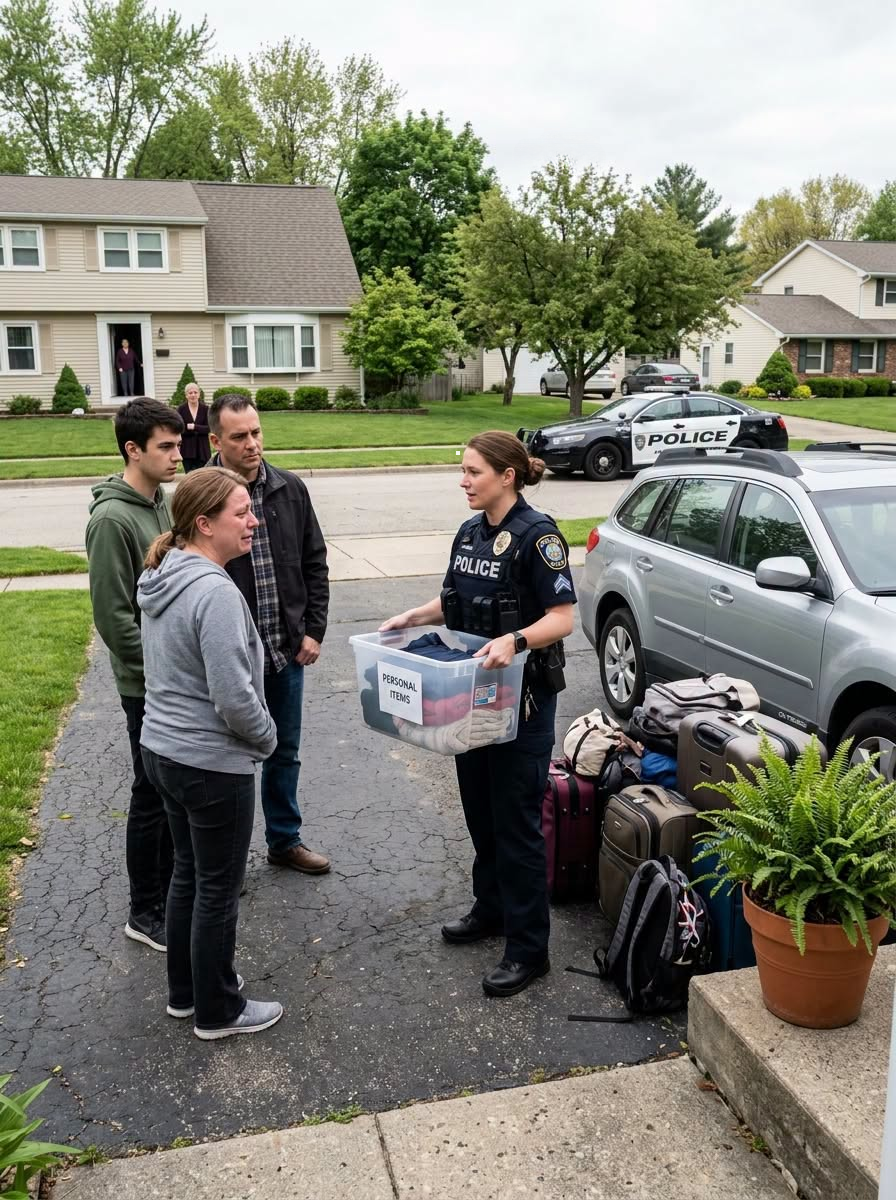
This had been prearranged. Lisa had driven the car. Lisa was carrying a storage bin. The back of the SUV contained three rolling suitcases, two bins, a garment bag, a canvas tote, and, for reasons I cannot explain and have not been able to clarify since, a peace lily.
I recall glancing at the peace lily and thinking it had received more advance notice about its living situation than I had.
The doorbell rang.
I opened the door.
Diane smiled.
She asked: which room did Mark clear out?
I replied: he didn’t.
The smile vanished.
She inquired what I meant.
I said: he didn’t clear out a room.
Lisa adjusted the bin on her hip.
She said: oh Claire, don’t start.
I replied: I haven’t started anything. You’re the ones standing on my porch with luggage.
Diane asserted that Mark had said she could stay.
I said: I know what Mark said.
She instructed me to move, claiming the bags were heavy.
I remained where I was.
I said: Diane, you’re welcome to come in and sit down. You’re not moving in today.
The conversation that followed I will not recount in its entirety because it spanned the length of two women asserting the same points in different tones, Diane from a stance of conviction that Mark’s word was sufficient authorization, and me from an equally firm position that it was not.
Lisa pulled out her phone.
She aimed it at me.
I said: no.
She asked: what are you afraid of?
I replied: mostly being bored to death watching this later.
Diane called Mark. No answer. She called again. No answer.
She stated: my son owns this house.
I almost corrected her.
The words were right there, the statement that was accurate and obvious and would have resolved the question neatly. The house is in my name, Diane. I own it. I bought it two years before I met your son.
I didn’t say it.
And I want to be candid about why I refrained from saying it, because the honesty is what matters.
I didn’t say it because I realized, in that moment, that correcting Diane would have meant addressing a misunderstanding that Mark should never have allowed to persist. Mark knew whose name was on the mortgage. Mark had lived in this house for nine years. Mark had filed taxes that listed this address and this mortgage and this homeowner’s insurance under Claire Bennett’s name.
If Diane believed this house belonged to Mark, that belief had been shaped by something, and that something was the lack of any correction from the person who knew the truth.
Diane understood the narrative that Mark had permitted.
And I wanted Mark to be the one to amend it.
She was already dialing another number.
Lisa said: Mom, don’t.
I asked who she was calling.
She replied: 911.
I genuinely thought she was bluffing.
She was not.
When the dispatcher answered, Diane said, at a volume that could be heard by neighbors three properties in each direction, that her daughter-in-law had locked her out of her son’s house.
I stood in the doorway.
I had every document I needed. The deed was in the file cabinet in my office, the office that had apparently already been designated for a new purpose by my husband without my input. The mortgage statement, the tax records, the homeowner’s insurance policy, all of it was thirty feet from where I stood.
I did not retrieve it.
I remained in the doorway and awaited Mark.
At 5:34, Mark’s car entered the driveway.
Almost simultaneously, Officer Ruiz’s cruiser turned the corner.
Mark saw his mother.
He saw Lisa.
He saw the suitcases.
He noticed the flashing lights.
For the first time that afternoon, he appeared to be a man who fully understood how badly he had misjudged the situation.
I opened the door a bit wider.
Not for Diane.
For the truth to have space to enter.
Officer Ruiz exited with the specific expression of a man who has spent his shift explaining obvious matters to individuals who did not want them explained. He had the methodical demeanor of someone who has discovered that the quickest way through a complicated domestic issue is to ask clear questions and wait for the responses.
Diane approached him immediately.
She said: officer, thank goodness.
Mark was still by his car, shifting his gaze between his mother and me, calculating. That troubled me more than I anticipated. Not because I needed him to stand beside me. But because he looked like a man trying to determine which side of a situation would cost him less, and the thing he was calculating the cost of was the truth about his own house.
Ruiz glanced at the suitcases.
He asked who had made the call.
Diane replied that she had.
He requested her to explain what was happening.
She stated that her daughter-in-law was refusing to allow her into her son’s house.
Lisa, still clutching the storage bin, nodded in agreement.
Ruiz looked at me.
He said: ma’am?
I said: my name is Claire Bennett. I reside here.
He said: okay. Does Mrs.
He glanced at Diane.
He asked if she lived at this address.
She replied that she was moving in that day.
He asked: have you lived here before?
She answered no.
He inquired: do you currently receive mail here?
She stated no, but her son had told her she could stay.
He looked at Mark.
He asked Mark if he owned the property.
The silence that followed that question was the kind of silence that carries its own weight, that hangs in the air and makes everyone present aware of its significance.
Mark looked at me.
Then at his mother.
Then at Officer Ruiz.
He said: Claire, can we please stop embarrassing everyone?
I had anticipated numerous responses from Mark at that moment.
I had expected him to say: Officer, the house is Claire’s. I should have consulted her before any of this was arranged, and I apologize for the misunderstanding.
I had expected him to say: Mom, I’m sorry, I mishandled this, and I need to fix it.
I had anticipated some form of accountability.
What I received was: can we please stop embarrassing everyone.
Not we mishandled this.
Not I mishandled this.
Not even the active construction that would have indicated awareness of his own involvement.
Can we please stop embarrassing everyone, directed at me, which implied: you, Claire, stop making this uncomfortable by insisting on the truth.
Officer Ruiz waited.
He said: sir, I still need an answer.
Mark said: it’s complicated.
I replied: it isn’t.
Everyone looked at me.
I stated: the house is in my name. I purchased it in 2011, two years before Mark and I met. My name is the sole name on the deed and the mortgage. Mark has never been on the title.
The silence shifted now.
Diane’s expression transformed from indignation to something I can only describe as recalculating, the specific look of someone whose understanding of a situation has just encountered information that doesn’t fit.
Lisa had lowered the storage bin.
Mark was gazing at the driveway.
Officer Ruiz nodded.
He said: so you’re the homeowner.
I said: yes.
He continued: and you weren’t consulted about Mrs. Bennett moving in.
I replied: my husband informed me by text at four-seventeen this afternoon that his mother was moving in. I was told it was already decided. I called him to discuss it, he ended the call and did not respond to my callbacks, and forty-five minutes later his mother arrived with luggage.
Ruiz stated: and you declined to let her in.
I said: I told her she was welcome to come inside as a guest. I said the luggage would need to stay outside until my husband and I had a conversation. She called the police.
Ruiz looked at Diane.
He stated: ma’am, the homeowner has the right to determine who does and does not move into the property. Your son making that commitment without her consent does not create a legal right to occupy the home.
Diane replied: she’s my son’s wife.
He said: yes ma’am. That doesn’t alter property law.
He turned to Mark.
He said: sir, you may want to talk with your wife about how you’d like to manage this moving forward.
Then he asked if there were any other concerns, and when no one had any, he returned to his vehicle, and the cruiser rolled down the street, leaving us standing in the driveway in the late afternoon.
For a moment, no one spoke.
Lisa set the storage bin down on the concrete.
Diane removed her sunglasses.
She looked at me, then at Mark, and the look held a quality I had not witnessed from her before, something that was neither the warm conditionality nor the affectionate assumption, but something more vulnerable.
She said: you told me this was your house.
Mark replied: I never said that.
Diane responded: you never said it wasn’t.
Mark fell silent.
I had mentioned, prior to the officer’s arrival, that the silence carrying its own weight was significant. This silence felt heavier. It was the silence of a family grasping something about itself that it had been arranged, for a long time, not to comprehend.
I said: Diane, would you like to come inside?
She gazed at me.
I said: I mean it. Come in. Lisa too. We should all talk.
It wasn’t hospitality for its own sake. It wasn’t generosity in any pure sense. It was the acknowledgment that what was about to unfold needed to happen in a room with seats, where people could sit down with something to hold, where the discussion could have the space it needed.
We went inside.
I turned on the kettle, as the kettle is the gesture I use when I need time to gather my thoughts, the ritual of making tea being long enough to collect oneself without appearing to be doing so.
Diane sat at the kitchen table.
Lisa took a seat beside her.
Mark lingered in the hallway for a moment before joining us at the table.
I placed cups in front of everyone.
I sat down.
I said: Mark, I want to express something and I need you to allow me to finish before you respond.
He said: okay.
I said: this house has been mine for twelve years. It was mine when we met and it was mine when we wed, and it has remained in my name every year of our marriage. You have known this for the entire nine years we have been together. And at no point, in nine years of comments from your mother about how fortunate I was that you provided so well and how nice it must be not to worry about money, did you correct her.
He said: Claire.
I said: I’m not finished.
He said: okay.
I said: I don’t know why you didn’t correct her. I can think of reasons. Perhaps you thought it was harmless. Maybe you believed the distinction wasn’t significant. Perhaps there was something in the narrative that was beneficial to you, that it felt simpler to be perceived as the provider in a traditional sense than to explain that your wife bought the house before you arrived. I don’t know. But I need you to understand that the version of our marriage that your mother and sister believe in is not the marriage we have.
Diane said: Mark.
He looked at his mother.
She asked: is this true?
He said: the house is Claire’s. I’ve always known that.
She said: you never told me.
He replied: it didn’t come up.
She said: I made comments for nine years about this woman’s house being your house. You let me.
He said: Mom.
She responded: don’t Mom me. I have spent nine years believing something that wasn’t true because you never bothered to correct me.
This was not the direction I had anticipated the conversation to take.
I looked at Diane.
She looked at me.
She said: I owe you an apology.
I said: for calling the police?
She said: for nine years of comments. I didn’t realize what I was saying. I thought I was discussing your husband’s success. I didn’t comprehend that I was diminishing yours.
I said: I understand you didn’t know.
She said: that doesn’t make it better.
I said: no. It doesn’t. But it alters the situation.
Lisa said: I should also.
She paused.
She said: the camera thing was.
I interrupted: unnecessary?
She said: I was trying to assist Mom.
I said: I know.
She said: but it wasn’t helpful.
I said: no.
Mark had been very quiet.
He said: I should have consulted you. About Mom. Before I mentioned anything to her.
I said: yes.
He said: I just. She called me upset about the rent, and I said it would be fine.
I replied: and you meant that it would be fine for you.
He said: I thought you would be okay with it.
I said: you assumed that if you framed it as already decided, it would be simpler than asking.
He fell silent.
I said: you were attempting to avoid the conversation.
He said: yes. I think I was.
I asked: why?
He said: because I knew what you would say.
I said: what would I say?
He said: that she had other options. That the senior community in Lanexa was available. That we should have talked about it first.
I stated: those are all accurate things to say.
He said: I know.
I said: so you were already aware of the right answer and chose to evade it.
He said: I didn’t want to disappoint her.
I said: at my expense.
He was very still.
He said: yes.
He said it with the specific tone of someone who has identified a truth about themselves they would have preferred to ignore, the flatness of an accurate and uncomfortable self-assessment.
I said: Mark, I love you. I’ve loved you for nine years and the marriage has been good in ways I don’t want to lose. But you sent me a text stating it was already decided. That’s not how we make decisions.
He said: I know.
I said: and when Officer Ruiz asked you whose house it was, you said it was complicated. It’s not complicated. It’s my house. You have known that for nine years. And in that moment, you chose to shield yourself from the awkwardness of admitting it rather than speak the truth.
He said: Claire.
I said: I need you to grasp what you did in that moment.
He said: I embarrassed you.
I said: you left me standing in my own driveway without the most basic acknowledgment of what is real. I wasn’t asking you to defend me. I was asking you not to abandon me. And you stood there calculating.
He placed his hands on the table.
He said: I’ve been miscalculating a lot of things.
Diane said: Mark, the senior community in Lanexa.
He looked at her.
She said: I should reconsider it.
He said: Mom, you don’t have to.
She replied: yes, I believe I do. I came here with my luggage and my expectations without asking. I just assumed because you told me it was fine, and because.
She paused.
She continued: because I didn’t think about Claire. I thought about you and me and Lisa and what was convenient, and I treated this house as if it were mine to make decisions about because your father’s house was my house to make decisions about, and I carried that forward without considering whether it was true here.
She stated: it’s not true here.
I said: Diane.
She looked at me.
I said: the offer stands. If you need a place to be while you figure out a better arrangement, you can stay here for a few weeks. As a guest. In the guest room, which I will choose.
She asked: why?
I said: because you’re seventy-four and because your rent increased and because despite everything that transpired this afternoon, you’re family.
She said: after I called the police.
I replied: yes.
She said: that’s very.
She paused.
She asked: why?
I said: because the way today unfolded was not entirely your fault. You were given a version of this situation that made your actions seem reasonable. That version was incorrect. That’s on Mark, not you.
Mark said: Claire.
I said: I’m not saying it to be unkind. I’m saying it because it’s true and needs to be acknowledged.
He said: you’re right.
I said: I know.
Lisa said: what about me?
I turned to her.
She said: I drove her here. I knew we hadn’t spoken to you first. I did it anyway.
I said: yes.
She said: I convinced myself Mark had taken care of it.
I said: you were aware he hadn’t.
She said: yes.
She said: I wanted it to work out for Mom and thought that if she was already here, it would be harder for you to decline.
I said: yes. That’s what you believed.
She said: that was wrong of me.
I said: yes.
She said: I’m sorry.
I said: I hear you.
The tea had cooled slightly.
I got up and put the kettle back on.
We remained in the kitchen for another hour.
Mark and I did not resolve everything that evening. There were things discussed in that kitchen that opened doors which then needed to be approached carefully, over days and weeks and eventually months, in conversations that were sometimes challenging and sometimes fruitful and sometimes both simultaneously.
What we did resolve that night was the immediate issue.
Diane would stay in the guest room for three weeks while she, Mark, and Lisa examined the senior community in Lanexa more seriously, and while they explored other alternatives, and while the question of what she truly wanted and what was genuinely available was scrutinized with the thoroughness it warranted.
She moved in the following day.
She brought the peace lily, which I placed in the kitchen window where it receives morning light, and where it is thriving.
The guest room was the back bedroom, the one with the lovely view of the yard, which Diane paused at for a moment when I showed it to her and remarked that she could see why I had chosen the house.
I replied: yes.
She said: it’s yours. I realize that now.
I responded: I know you do.
She continued: I should have asked.
I said: yes. But so should Mark.
She remarked: I believe Mark has a lot of asking to catch up on.
I said: he does.
She inquired: will he?
I said: I think he’s beginning to recognize what not asking costs.
She said: good.
She placed the peace lily on the windowsill in her room.
She said: I’m going to try not to be difficult.
I replied: I know you are.
She added: I can be difficult, though. Ask anyone.
I said: I know that too.
She almost smiled.
She said: Lisa claims I’m exhausting.
I said: Lisa drives you places, so she can’t find you too exhausting.
She responded: she finds me precisely that exhausting.
I said: yes.
She said: Claire.
I replied: yes.
She said: I asked Mark, years ago, why the house was in your name.
I went still.
She said: he told me it was a tax matter. That it was simpler. I didn’t inquire further.
I said: Diane.
She replied: I’m not making excuses. I could have asked you directly. I chose to accept his explanation because it was convenient.
I said: we all sometimes accept convenient explanations.
She asked: even you?
I said: especially me. I accepted that your remarks were merely old-fashioned for nine years because confronting what they actually signified was complicated.
She queried: what did they actually signify?
I said: they signified you believed this was Mark’s house and I was here because of him.
She said: yes.
She acknowledged: I think I did believe that.
I said: I know.
She continued: and now?
I said: now you comprehend what’s true.
She affirmed: yes.
She remarked: you built this.
I replied: yes.
She stated: and you allowed him in.
I said: yes.
She said: and he should have communicated that to me. He should have said: Mom, Claire built this, and I’m the fortunate one.
I said: yes. He should have expressed that.
She said: I’ll discuss it with him.
I expressed: I appreciate it.
She remarked: he needs to hear it from me too. Not because you can’t handle it yourself. You clearly can. But because it carries a different weight coming from his mother.
I said: yes. It likely does.
She said: he’s a good man.
I replied: he is.
She added: but he needs work.
I said: yes. Don’t we all.
She gazed at the yard again.
She asked: what did you plant out there?
I responded: the beds along the left side are herbs. The back corner is a kitchen garden. The roses on the right side were here when I purchased it. I preserved them.
She remarked: roses require pruning.
I said: yes.
She continued: I used to prune Mark’s grandmother’s roses. She had a row of them along the fence.
I said: I could use someone knowledgeable to help with them. I’ve been pruning incorrectly.
She said: you’ve probably been cutting them too short.
I said: yes.
She added: people tend to cut them too short. You have to trust that the long cut is the correct one even when it appears wrong.
I said: I’ll keep that in mind.
She said it without any apparent awareness that she had made a metaphor.
I left her to unpack.
I went to find Mark.
He was in the kitchen, where the kettle was still warm, where the cups from our discussion remained on the table. He stood at the counter in the specific manner of someone who has been stationary long enough to forget they are standing.
He asked: how is she?
I replied: I think she’s okay.
He queried: are you?
I said: I’m working on it.
He said: that’s fair.
I responded: yes.
He remarked: I should have asked you.
I affirmed: yes.
He stated: I should have informed her. About the house. Years ago.
I replied: yes.
He admitted: I don’t have a good justification for why I didn’t.
I said: I know. I’ve been reflecting on it.
He asked: and?
I said: I think you preferred the version where you were the provider.
He remained silent.
I said: I don’t think you crafted it intentionally. I believe you didn’t correct it because the lack of correction was comfortable and correcting it would have necessitated explaining something that might have complicated your self-perception.
He said: that’s.
He said: that’s uncomfortably accurate.
I replied: yes.
He said: I’m sorry.
I said: I know you are.
He asked: is sorry enough?
I said: it’s not nothing. What follows it is significant.
He said: what follows is that I rectify the narrative. With my mother, with Lisa, with anyone else who has been operating on the incorrect version.
I affirmed: yes.
He stated: and that when decisions involve this house, I consult you. Every time. Before I mention anything to anyone else.
I said: yes.
He continued: and that when a question arises that necessitates an honest answer, even an uncomfortable one, I provide it.
I said: yes.
He added: even when the honest answer casts me in a less favorable light.
I replied: the honest answer never truly makes you look less. The avoidance of it does.
He acknowledged: I understand that now.
I said: okay.
He asked: can we start from there?
I said: yes. We can start from there.
He mentioned: the house in Lanexa. The senior community. I’m going to take Mom next week and genuinely look at it with her. Not attempt to persuade her to go. Look at it with her.
I replied: that sounds right.
He added: and if she desires to stay here longer than three weeks.
I said: we discuss it. Together. Like adults sharing a life.
He said: yes.
He remarked: I’m going to prune those roses incorrectly my entire life, aren’t I?
I asked: what?
He said: I heard what she said. About the roses.
I replied: I cut them too short.
He said: so do I.
I said: well. Apparently, we’ve both been doing it wrong together. We can learn to do it right together.
He queried: is that a metaphor?
I said: your mother made the metaphor. I’m merely following her example.
He almost smiled.
It was the smile that had been one of the first things I had loved about him, the timing of it, the way it arrived slightly after the event that triggered it, the specific delay of a person who is genuinely amused rather than feigning amusement.
I said: go check on your mother.
He said: okay.
He departed.
I stood in the kitchen for a while.
I gazed at the house.
Twelve years in this house, the walls I had chosen and the kitchen I had updated and the yard I had cultivated and the roses I had been pruning incorrectly, and the file cabinet in the office containing the deed in my name and the mortgage statements in my name and the tax records dating back to 2011.
The house was mine in every legal and practical sense.
It was also, in the ways that matter when you have spent nine years forming a family with someone, ours.
The distinction between those two realities had not been clearly delineated, and clarifying it was the work that lay ahead.
But the work was feasible.
That was what Thursday had revealed to me, which was the specific awareness of what was still achievable and what needed to occur to make it possible. Not the confrontation I had hesitated to face for nine years, but the version of our marriage that could exist after the confrontation had taken place and the truth had been acknowledged and everyone in the kitchen had adjusted their grasp of what was true.
The peace lily was in the guest room window.
The roses required proper pruning.
We had tasks to tackle.
I placed the cups in the dishwasher and began preparing dinner, because dinner was the next step, and the next step is always the right place to start.