“Yes. Every word.”
The doctor recorded the statement exactly as Daniel had articulated it, then noted the time and the names of the staff who had listened through the door. The nurse informed him that he would not be allowed to enter my room.
Daniel slapped the door with his palm. “She’s my wife.”
I pressed both hands against the blanket to still their trembling. “That’s why I’m not leaving with you.”
A nurse set the overnight bag Daniel had brought on the chair. Inside were three blue newborn sleepers, a pack of diapers, and nothing for me except my wedding ring in a plastic bag. He had packed for the son he hoped to dominate and regarded his injured wife as something for another to manage.
I requested that they call Emily.
She arrived in jeans, worn sneakers, and the gray hoodie she always kept in her car. She didn’t inquire why I had ignored her calls for months. She sat beside the bed, took my hand without squeezing the IV line, and waited until I was ready to speak.
“I need somewhere to go,” I stated.
“You have one,” she replied.
Outside, Daniel continued insisting that the staff send Emily away. The doctor came back carrying a rigid back brace and placed it beside the bed.
“Before we discuss discharge,” she stated, “you need to comprehend what the spinal damage may signify.”
Emily’s grip on my hand tightened.
The doctor looked directly at me. “You may require assistance standing, bathing, and walking for an extended period. Thus, I need to ask you one question before anyone makes arrangements for you.”
She glanced toward the locked door.
“Who do you trust to help you when you cannot get up by yourself?”
I didn’t need to ponder the answer.
“Emily,” I replied. “I trust Emily.”
My sister leaned forward until her forehead touched the back of my hand, and for the first time that evening, I felt someone crying without making my pain about them.
The doctor nodded and clarified that the hospital would organize my care around the person I selected, not the husband waiting outside the locked door.
Daniel overheard enough through the wall to realize that control had shifted.
His tone changed from demanding to soft, which was always the version that frightened me the most.
“Rachel,” he called, “you are confused. Let me explain this to you.”
Emily glanced at the door, but I kept my gaze on the back brace.
For years, Daniel had treated explanation as ownership.
He explained why I didn’t need my own checking account, why my sister was a bad influence, why he should read my messages, and why every decision regarding my pregnancy belonged to him because the baby carried his name.
Now he wanted to explain why I had been tied upside down.
The doctor asked if I wanted to hear him.
“No,” I replied.
It was the first boundary I had stated without softening it for him.
Hospital staff moved Daniel away from the room after he refused to leave the hallway, and a staff member entered to ask if I was willing to give a full account of what happened.
The doctor stayed only long enough to clarify the medical findings.
She didn’t tell me what choice to make.
She informed me of what my body revealed.
The injuries around my ankles were consistent with prolonged pressure.
The damage along my spine matched traction and suspension, not a short fall.
The bruising across my abdomen was not accidental.
Most importantly, she stated that the loss of my baby was due to the trauma.
“Nothing you said, nothing you ate, and nothing you failed to do caused this,” she told me. “The person who hurt you caused this.”
I hadn’t realized how desperately I needed someone to say those words until my breath hitched in the middle of the room.
Daniel had spent months teaching me that anything wrong with the pregnancy would be my fault.
When I felt nauseated, he said I was weak.
When I needed to sit down at the grocery store, he accused me of embarrassing him.
When an early appointment didn’t confirm whether the baby was a boy, he drove home in silence and later asked if I had done something to “ruin it.”
I had laughed nervously because I thought the question was too ridiculous to be dangerous.
I was mistaken.
On the morning of the assault, Daniel had come home with a hard, fixed expression and asked why I had written two girl names on a scrap of paper beside the refrigerator.
I told him they were just names I liked.
He tore the paper in half and declared there would be no need for them.
I tried to exit the kitchen, but he took my phone and car keys and placed them on top of the refrigerator where I couldn’t reach comfortably.
Then he informed me he had read online that changing the baby’s position could alter what came out.
Even now, saying that sentence aloud made it sound impossible.
At the time, Daniel uttered it with complete confidence.
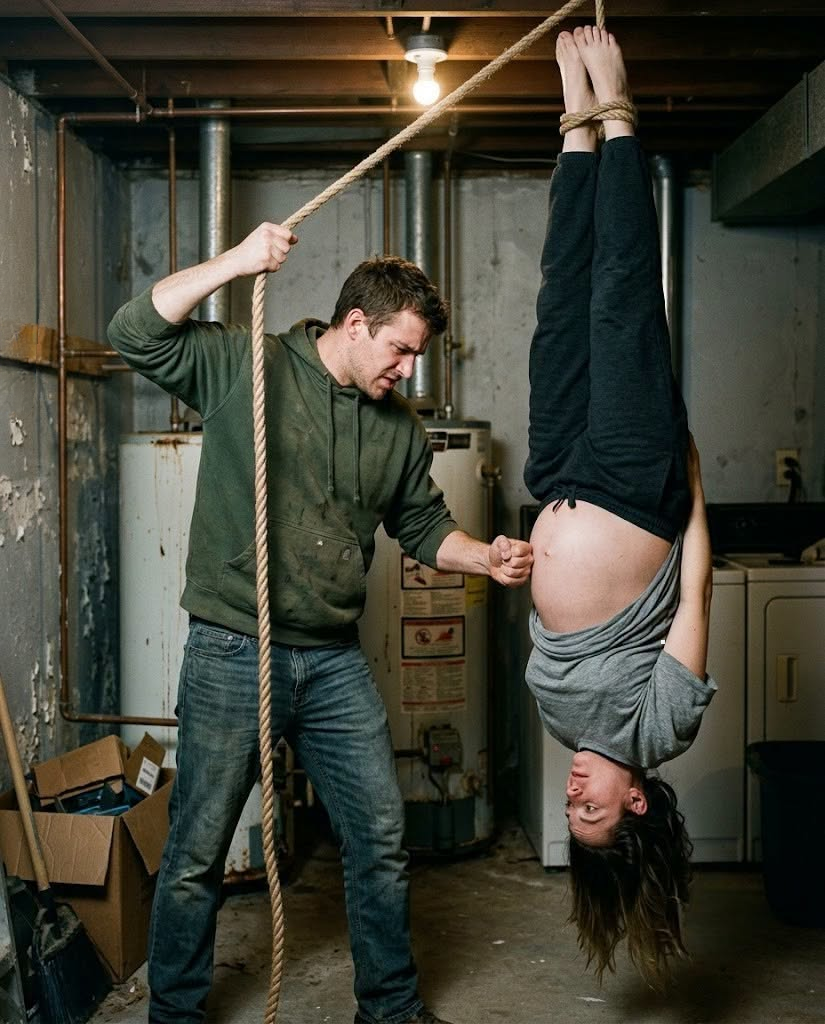
He led me toward the unfinished utility room at the back of the house, where an old wooden beam crossed the ceiling above the washer and dryer.
I noticed the rope only after he shut the door.
I told the staff member I had pleaded with him to stop.
I told her he claimed my fear was proof that I didn’t believe in him.
I recounted the concrete floor moving above my head, the metal side of the washing machine catching the light, and Daniel repeating that a wife who loved her husband would give him a son.
I didn’t describe every moment.
I didn’t need to.
The scans, the ankle marks, and Daniel’s own words in the hallway already conveyed the parts my voice couldn’t.
When I finished, the staff member read my account back to me in plain language.
There were no dramatic speeches and no promise that everything would be resolved by morning.
There was merely a record that didn’t belong to Daniel.
I signed it.
Emily signed nothing.
She simply stayed.
That night, she slept in a vinyl chair with her sneakers still on because the nurse indicated someone might need to help me reposition before morning.
Each time I awoke, Emily was there.
Sometimes she held a paper cup of water near my mouth.
Sometimes she adjusted the edge of the blanket so it didn’t pull against my IV.
Once, just before dawn, she whispered, “I’m sorry I stopped coming by.”
I turned my head toward her as far as the brace allowed.
“You didn’t stop,” I replied. “I stopped opening the door.”
Emily swallowed hard.
“Then I’ll keep knocking,” she said. “Quietly.”
The next day, Daniel attempted a different strategy.
He called Emily from an unfamiliar number and claimed the hospital was making the situation appear worse than it was.
He stated I was emotional due to the pregnancy loss.
He claimed he had only been trying to help.
Emily did not argue with him.
She asked one question.
“Why did you tell the doctor a son was important?”
Daniel was silent for several seconds, then said, “Because Rachel knew what was expected.”
Emily ended the call.
She didn’t record it or turn it into a second piece of evidence.
She only told me because I asked what he had said.
By that time, I understood that Daniel’s words were unnecessary to substantiate the injuries.
They indicated something else.
He still believed expectation was a justification.
The hospital restricted contact, and a responding officer later took the same account I had already provided.
I didn’t have to start over with a different story.
The medical report established the injuries, the doctor’s notes preserved Daniel’s hallway statement, and my own account explained the sequence.
Daniel was removed from the property before I was discharged.
I learned that fact without celebration.
Relief didn’t feel like victory.
It felt like being able to close my eyes without listening for his footsteps outside the door.
The deeper reversal came two days later when the doctor returned to discuss the scans again.
I thought she was going to reiterate the damage to my spine.
Instead, she asked what Daniel had told me about the baby.
I said he had insisted my body was failing him.
The doctor pulled a chair beside the bed.
“Your body protected that pregnancy for as long as it could,” she said. “What happened was not a failure of your body. It was an injury inflicted on you.”
I looked at my hands.
For months, Daniel had turned pregnancy into a test I was supposedly taking for him.
The doctor’s words transformed the question.
I hadn’t failed to give him a son.
He had assaulted a wife and a baby because neither could be controlled by his demands.
That truth didn’t lessen the grief.
It placed the grief where it belonged.
With him.
Emily assisted me in making a list before discharge.
It wasn’t a list of revenge.
It was a list of ordinary items I would need since standing and walking were now challenging: loose sweatpants, a shower chair, a firm pillow, slip-on shoes, medication, and a place where no one would touch my phone.
She drove to her apartment and moved a small table beside the guest bed.
She placed a charger within reach.
She cleared the hallway so my walker wouldn’t catch on a basket or rug.
She set the coffee maker on a lower counter because I couldn’t bend or stretch safely.
Care looked nothing like Daniel’s speeches about family.
It resembled making room.
Before Emily went to gather a few belongings from the house, she asked what mattered most.
I thought about wedding photos, furniture, the dishes my mother gave me, and the box of baby clothes.
Then I recalled the overnight bag Daniel had brought to the hospital.
Three blue sleepers.
Diapers.
My wedding ring sealed in plastic.
He had determined what the baby would be, what kind of wife I would remain, and where I would go after he harmed me.
“Bring my identification,” I instructed Emily. “Bring the green sweater from the back of the closet. Leave the rest.”
She scrutinized my face.
“Even the ring?”
“Especially the ring.”
Emily nodded.
That was the irreversible choice Daniel had never imagined I would make.
I wasn’t waiting for him to feel sorry enough.
I wasn’t negotiating for a gentler version of the same home.
I was leaving the life where his explanations always followed his cruelty and somehow erased it.
The first week at Emily’s apartment was humiliating in ways I hadn’t anticipated.
I needed assistance sitting up.
I needed help washing my hair.
I cried the first time a spoon slipped from my hand because the pain medication made my fingers clumsy.
Emily never told me to be grateful.
She never said I was lucky.
She picked up the spoon, rinsed it, and brought me another one.
At night, I awoke with the sensation that the floor was above me.
My ankles burned even when nothing touched them.
The ceiling fan made me nauseated, so Emily removed it and replaced it with a plain light fixture.
She didn’t ask if that was reasonable.
She asked if it helped.
Physical therapy commenced with movements so small they felt insulting.
Lift one foot.
Press the heel down.
Shift weight without twisting.
Stand for five seconds.
I wanted the therapist to understand that I had once carried groceries, folded laundry, and climbed stairs without thought.
Instead, I gripped the walker and counted.
Five seconds became ten.
Ten became twenty.
Weeks later, I traversed the apartment from the guest room to the kitchen while Emily walked beside me with both hands ready but not touching.
Halfway there, I halted.
“I can’t do this,” I said.
Emily glanced at the chair behind me and the counter ahead.
“You can sit,” she said. “Or you can take one more step. Both choices are yours.”
The sentence was so ordinary that it nearly broke me.
Both choices are yours.
Daniel had made every choice sound like a test of loyalty.
Emily made choice sound like what it was.
Mine.
The legal case progressed slowly.
There were forms, appointments, and days when I wished never to hear Daniel’s name again.
A temporary no-contact order meant he couldn’t come to Emily’s apartment or contact me directly.
He began sending messages through relatives at first, claiming he had lost his temper due to pressure.
I refused to respond through them.
The report didn’t describe what happened as “pressure.”
It outlined suspension injuries, abdominal trauma, spinal damage, and fetal death.
Plain words made it harder for anyone to carry his excuse into the room.
One relative informed Emily that Daniel had always talked about wanting a boy.
Emily responded, “Wanting something is not permission to destroy someone.”
Then she changed the subject.
We didn’t structure my recovery around convincing those who preferred his version.
We built it around appointments, medication schedules, rent, groceries, and rest.
Money was tight because I couldn’t return to work right away.
Emily took on extra hours and tried to conceal the strain.
I noticed anyway.
The old Rachel would have apologized until the apology became another burden.
Instead, I asked what I could do from bed.
I began managing the household bills online, planning grocery orders, and calling insurance offices when claims were delayed.
Small responsibilities restored a shape Daniel had tried to erase.
Months after the assault, the doctor cleared me to walk short distances with a cane.
Emily drove me to a quiet park near her apartment, where the path was flat and the benches were close together.
There were no speeches.
She carried two paper coffee cups and kept pace beside me.
At the first bench, I sat and cried because my back hurt.
At the second, I cried because I had reached it.
The baby remained part of every step.
People sometimes spoke about the loss as if it were a separate tragedy from what Daniel did.
It was not separate.
But my baby was also more than evidence in a case.
One evening, I asked Emily to sit with me while I wrote a letter.
I didn’t choose a name Daniel would have approved or rejected.
I wrote only, “You were loved before anyone tried to turn you into a demand.”
I folded the letter and placed it in a small wooden box with the two halves of the name list Daniel had ripped.
Emily had found them under the refrigerator when she retrieved my identification.
The scraps were not proof we needed.
They were a reminder that my baby had been allowed possibilities, even if only on paper.
At the next medical follow-up, the doctor asked if I was safe.
“Yes,” I replied.
Then I corrected myself.
“I am becoming safe.”
Safety wasn’t a door that locked once.
It was a series of choices I kept making: keeping my number private, attending therapy, accepting help, telling the truth without trimming it to protect Daniel, and refusing to return to a house simply because my name was still on the mail.
The criminal case eventually advanced based on the medical evidence, the hospital witnesses, and my statement.
Daniel’s attorney tried to characterize the event as a misunderstanding during a mental-health crisis, but Daniel had sought no emergency help for himself and had offered no confusion when he told the doctor a son was important.
The case didn’t rely on a perfect recording or a surprise witness.
It depended on the fact that my injuries matched my account and did not align with his.
I was not required to confront him in a dramatic hallway confrontation.
My statement was sufficient to begin.
Months later, Daniel accepted responsibility in court rather than force a trial.
I will not pretend the outcome returned what was lost.
No sentence could restore my baby.
No order could erase the pain in my back or the nights when I awoke reaching for a floor that was not above me.
But the official record used the word “assault.”
It did not say misunderstanding.
It did not say discipline.
It did not say a husband trying to help.
When I heard that word read aloud, I felt the same shift I had felt when the doctor first asked if I wanted Daniel’s words entered into the report.
The truth now had a place outside my body.
I no longer had to bear all of it alone.
A year after the assault, I moved into a small apartment of my own.
Emily assisted in assembling a table and complained that the instructions had been written by someone who hated furniture.
I stood at the counter with my cane propped nearby and made coffee while she argued with a drawer.
The scene was so normal that I kept scanning for danger.
There was none.
I still noticed the ceiling.
For a long time, every exposed beam, hanging plant, or dangling cord pulled me back into that utility room.
In my new apartment, the ceiling was plain and low.
I chose a simple lamp with no hanging chain.
That choice mattered more than it should have.
On the first evening, Emily carried in grocery bags and started putting things away as if she lived there.
I took the milk from her and placed it on the shelf myself.
She watched my hands, ready to help.
I shook my head.
“I have it.”
She let go.
Daniel once believed turning my body upside down would force life to obey him.
He was wrong about my baby, wrong about my body, and wrong about what fear could keep forever.
I still notice ceiling beams.
I just no longer mistake fear for a home.