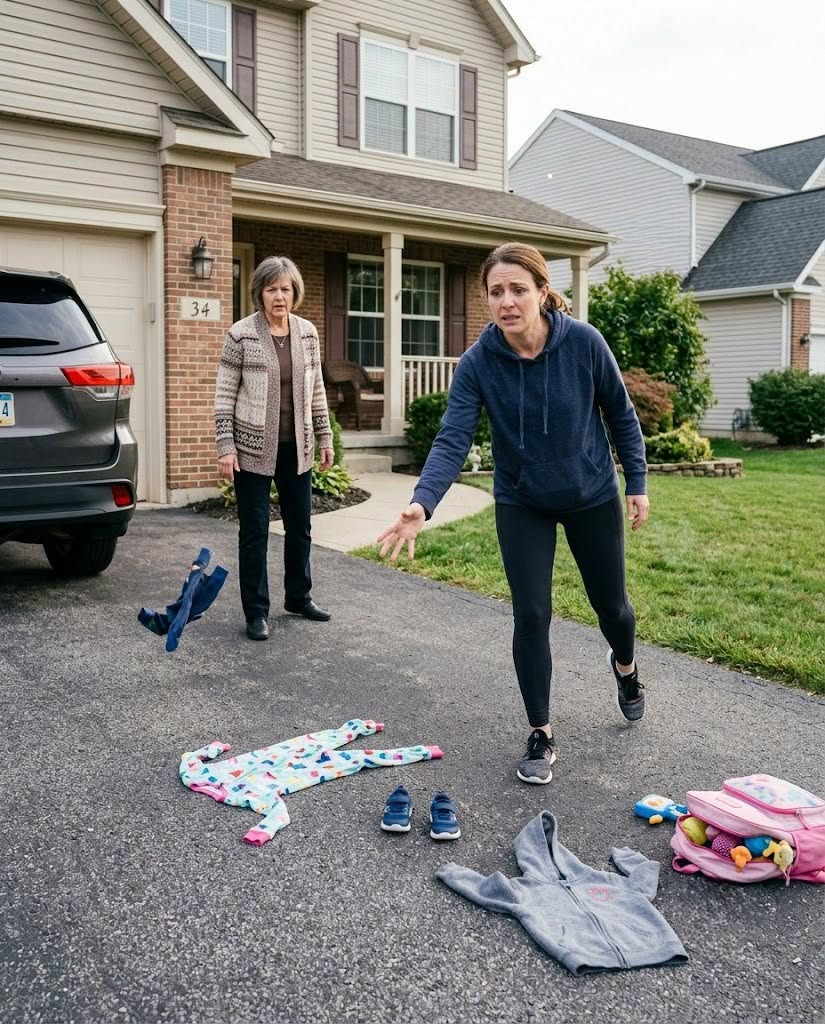
The garments landed on the pavement before I fully grasped what I was witnessing.
Small shirts.
Two pairs of shoes.
A pink winter coat.
My twins’ cherished stuffed rabbit.
Everything strewn across the street.
My mother-in-law stood on the front porch with a smile.
“Your mother married into this family,” she told my children. “You did not.”
For a few seconds, no one moved.
My eight-year-old twins, Emma and Noah, gazed at their possessions beside the curb.
Then Emma began to weep.
That was when something shifted within me.
I am Laura Mitchell.
And up until that afternoon, I had spent twelve years striving to maintain harmony with my husband’s family.
I had not succeeded.
Not because I was unkind.
Not because I was disrespectful.
But because peace was never their intention.
They sought control.
My husband, Daniel, hailed from a family that viewed marriage as an acquisition.
When we wed, his mother, Patricia, made it evident that I was entering their realm.
Not establishing my own.
Initially, her remarks seemed almost benign.
“In our family, we celebrate Christmas in this manner.”
“In our family, wives support their husbands.”
“In our family, property remains with blood relatives.”
I smiled.
I overlooked it.
I convinced myself she was simply old-fashioned.
Then Emma and Noah were born.
That altered everything.
Patricia adored Daniel.
She tolerated me.
Yet she regarded the twins as if they belonged to some ambiguous category between family and outsiders.
It was illogical.
They were Daniel’s children.
Her grandchildren.
Still, Patricia repeatedly made peculiar comments.
“They resemble your side more.”
“They have your family’s demeanor.”
“They don’t grasp how the Mitchells operate.”
Daniel always brushed it off.
“That’s just Mom.”
I despised those words.
That’s just Mom.
They clarified everything and excused nothing.
Regardless, life continued.
Daniel worked in commercial insurance.
I managed a small accounting firm from home.
We purchased a lovely house outside the city when the twins were four years old.
At least, everyone presumed we bought it together.
That detail would later become more significant than anyone anticipated.
The house had belonged to my grandmother.
She raised me for several years after my parents’ divorce.
Upon her passing, she left it to me.
Not to Daniel.
Not to both of us.
To me.
The deed was entirely in my name.
Daniel was aware.
He never minded.
“We’re married,” he said. “It’s our house.”
And emotionally, I concurred.
Legally, however, it was mine.
Patricia apparently never grasped that distinction.
Or perhaps Daniel never clarified it.
Four months before everything unfolded, Daniel was offered a temporary position overseas.
The contract was for six months.
It was lucrative.
He was hesitant because of the twins.
I urged him to accept.
We had navigated challenging schedules before.
Video calls existed.
Six months would go by swiftly.
Patricia loathed the idea.
“You shouldn’t be alone in that large house.”
“I’m not alone.”
I gestured toward Emma and Noah.
She didn’t find it amusing.
Two weeks after Daniel departed, Patricia and her husband, Robert, began showing up constantly.
Initially, they brought groceries.
Then Robert started inspecting things.
The furnace.
The garage.
The locks.
One afternoon, I discovered him measuring the guest bedroom.
“What are you doing?”
“Thinking ahead.”
“For what?”
He grinned.
“Nothing.”
That response made me uneasy.
Then Patricia began criticizing how I managed the home.
“You waste electricity.”
“You let the children run amok.”
“You should keep Daniel’s office locked.”
“This house requires stricter family oversight.”
I finally pushed back.
“Patricia, this is my home.”
Her expression shifted.
“No, dear. This is Daniel’s family home now.”
I laughed because the statement seemed absurd.
She didn’t.
A week later, I called Daniel.
“Your parents are acting strange.”
He sighed.
“What happened?”
I explained.
There was a long pause.
“I’ll speak to them.”
He did.
For three days, everything was quiet.
Then Patricia became more aggressive.
She began showing up unannounced.
She criticized my parenting.
She rearranged kitchen cabinets.
She dictated to the twins which rooms they were “allowed” to use.
One afternoon, I caught her sifting through paperwork in Daniel’s office.
“What are you searching for?”
She turned around slowly.
“Insurance documents.”
“Why?”
“Family business.”
I stepped between her and the desk.
“You need to leave.”
Patricia looked at me as if I had slapped her.
“You’re asking me to leave my son’s house?”
“Yes.”
She smiled.
That smile should have alerted me.
“Be cautious, Laura.”
“About what?”
“You’re forgetting your position.”
I called Daniel again.
This time, I was furious.
“I don’t want them here without permission.”
“I understand.”
“No, Daniel. I mean it.”
“I’ll take care of it.”
But he was thousands of miles away.
And his mother had decided that distance granted her power.
Three days later, the twins and I went shopping after school.
We were gone for about ninety minutes.
Upon our return, our garage door wouldn’t open.
I pressed the remote again.
Nothing.
Then my phone failed to unlock the front door.
We had electronic locks linked to an app.
The app displayed:
ACCESS DENIED.
At first, I thought the system had malfunctioned.
Then I saw our belongings.
Boxes were piled near the driveway.
Clothing covered the curb.
Emma’s backpack lay in the gutter.
And Patricia stood on the porch.
Robert was behind her.
“What are you doing?”
My voice came out almost as a whisper.
Patricia crossed her arms.
“Making a necessary adjustment.”
I approached the house.
She blocked the steps.
“Move.”
“You’re not coming inside.”
“This is my house.”
“No.”
She smiled.
“This is Daniel’s house.”
Noah began to cry.
“Grandma, why are our things outside?”
Patricia looked directly at him.
Then she uttered something I will never forgive.
“Because your mother married into this family.”
She paused.
“You didn’t.”
Emma erupted in tears.
I felt something icy flow through my body.
Not fear.
Clarity.
I pulled out my phone.
“Laura,” Robert warned.
I ignored him.
I dialed the police.
Patricia laughed.
“You’re calling the police on the owners?”
I gazed at her.
“No.”
“I’m calling the police on individuals illegally locking children out of their home.”
Her smile faded slightly.
But not enough.
Then she did something astonishing.
She called the police as well.
She claimed I was trespassing.
Ten minutes later, two patrol cars arrived.
The first officer introduced himself as Officer James Carter.
He looked from the clothing in the road to my weeping children.
Then toward Patricia.
“What occurred?”
Patricia responded immediately.
“My son owns this property.”
Officer Carter raised a hand.
“Ma’am, I’d like to hear one person at a time.”
She continued regardless.
“My son is overseas. This woman has been causing problems. We revoked her access until he returns.”
“This woman?”
Officer Carter looked at me.
“I’m his wife.”
Patricia interrupted.
“Soon to be his former wife, if my son has any sense.”
I stared at her.
That was new.
Officer Carter's expression hardened.
“Who resides here?”
“I do,” I replied.
“With my children.”
“How long?”
“Four years.”
He turned to Patricia.
“Do you live here?”
“No.”
Robert answered for her.
“But our son owns it.”
Officer Carter studied the electronic keypad.
“Who disabled her access?”
“I did,” Robert said with pride.
“I’m the administrator on the security system.”
The second officer glanced at him.
“That’s not the same as owning the property.”
Robert frowned.
Officer Carter requested identification from everyone.
Then he inquired whether I had proof of residency.
“My wallet is inside.”
Patricia smiled again.
Of course it was.
So were my laptop.
My passport.
The twins’ medication.
Everything.
“I can pull records from my phone,” I said.
Patricia chuckled.
“Go ahead.”
She was entirely confident.
That was the strange part.
She genuinely believed she was right.
I opened my banking app first.
Then utility statements.
All displayed my name and the address.
Officer Carter nodded.
“That establishes residency.”
Patricia stepped forward.
“But not ownership.”
“You’re correct.”
She smiled.
Then Officer Carter returned to his patrol car.
A few minutes later, he returned holding a tablet.
He looked at me.
“Mrs. Mitchell?”
“Yes?”
“Can you confirm your full legal name?”
“Laura Anne Mitchell.”
He nodded.
Then he looked at Patricia.
“Ma’am, you said your son owns this property?”
“Yes.”
“He does not.”
Silence.
Patricia blinked.
“What?”
Officer Carter turned the tablet around slightly.
“The property record lists one owner.”
He read my name.
“Laura Anne Mitchell.”
No one moved.
Robert stepped forward.
“That can’t be right.”
“It is.”
“My son pays the mortgage.”
“There is no mortgage,” I stated.
Everyone looked at me.
My grandmother had paid off the house years before her death.
Patricia stared.
“But Daniel said this was his house.”
“It’s our home.”
I emphasized the next words.
“But legally, it belongs to me.”
The officer looked at Robert.
“You disabled the owner’s access to her own residence?”
Robert’s face turned pale.
“I thought—”
“That wasn’t my question.”
“Yes.”
“And you removed her property?”
Patricia interrupted.
“We were protecting our son.”
“From his wife?”
“She doesn’t belong here without him.”
Officer Carter looked toward Emma and Noah.
They were standing beside their clothes in the road.
Then he looked back at Patricia.
“Those children live here too.”
Patricia remained silent.
The officer continued.
“You do not have the authority to remove residents from property you do not own.”
Her face tightened.
“This is a family matter.”
“Not when you lock legal occupants out of their home.”
Her smile finally vanished.
I wish I could say I felt triumphant.
I didn’t.
I felt drained.
My children were crying.
Our belongings were scattered across the street.
And individuals who claimed to love them had intentionally humiliated them.
Officer Carter asked if I wanted Patricia and Robert removed from the property.
I looked at them.
Patricia’s eyes widened.
“You wouldn’t.”
That sentence answered the question for me.
“Yes,” I said.
“I want them removed.”
Robert began to argue.
Patricia called me ungrateful.
Officer Carter repeated the instruction.
They had to leave.
Patricia pointed at me.
“My son will hear about this.”
“I hope he does.”
She stepped closer.
“This marriage is over.”
Perhaps she expected fear.
Instead, I said the first completely honest thing I had told her in years.
“If Daniel agrees with what you did today, then yes.”
That silenced her.
They departed.
The police stayed until I regained access to the house.
Robert had altered administrator permissions on the security system.
A technician needed to reset everything.
Officer Carter helped move boxes away from the street.
The second officer picked up Noah’s stuffed rabbit.
He brushed dirt from its ear.
Then returned it.
That simple act made me cry.
Inside, the house appeared as if someone had ransacked it.
Drawers were open.
Closets had been emptied.
My office had been disturbed.
Then I noticed something missing.
The file box containing my property documents was gone.
I called Officer Carter before he left.
He came back inside.
“What was in it?”
“The deed.”
“Anything else?”
“Estate documents. My grandmother’s records. Insurance papers.”
His expression changed.
“Do your in-laws have access to those documents?”
“They did today.”
That altered the situation.
Patricia and Robert had not merely thrown us out.
They may have removed paperwork intentionally.
Police contacted them.
Robert initially denied having anything.
Then Patricia claimed the documents belonged to Daniel.
Eventually, officers recovered the box from their vehicle.
Every document was still there.
But something unusual had been added.
A photocopy of my deed.
Across the top, Robert had written:
TRANSFER?
My stomach twisted.
The following morning, I hired an attorney.
Her name was Michelle Grant.
I showed her everything.
Police reports.
Security logs.
Photographs.
The recovered file.
She examined the photocopy.
“Do you know why he wrote this?”
“No.”
“Has your husband ever asked you to transfer ownership?”
“Never.”
“Has anyone?”
“No.”
Michelle leaned back.
“Then we need to secure your records.”
She assisted me in placing additional protections around important documents and accounts.
We changed every lock.
Every password.
Every digital permission.
Then I called Daniel.
It was nearly midnight where he was.
He answered promptly.
“Laura? Mom called me.”
“Good.”
“She says you had them arrested.”
“They weren’t arrested.”
“That’s not what she said.”
I felt frustration rising.
“Did she mention throwing our children’s clothes into the street?”
Silence.
“What?”
So she hadn’t.
I told him everything.
The lockout.
The clothes.
The police.
The deed.
The copied document.
When I finished, Daniel remained silent for almost a minute.
Then he whispered.
“They did what to Emma and Noah?”
That was when I realized Patricia had miscalculated.
Daniel cherished our children.
He could excuse his mother insulting me.
He could not excuse her humiliating them.
He flew home three days later.
Patricia demanded a family meeting.
I refused to have it inside my house.
We convened at Daniel’s sister’s home.
Patricia arrived carrying a folder.
She looked offended rather than ashamed.
“This has gone far enough.”
Daniel glared at her.
“You threw my kids’ clothes into the road.”
“I was teaching Laura a lesson.”
“A lesson?”
“She keeps acting like she owns everything.”
Daniel chuckled once.
“She does own the house.”
Patricia froze.
“You knew?”
“Of course I knew.”
“Then why did you let us believe—”
Daniel interrupted.
“I never said it was mine.”
Robert spoke.
“You called it your house.”
“It’s where I live.”
“That doesn’t make me the owner.”
Patricia appeared genuinely stunned.
Then angered.
“So she holds all the power?”
I finally understood.
That was what this had always been about.
Power.
Not family.
Not tradition.
Not protecting Daniel.
Power.
I looked at her.
“No, Patricia.”
“I hold the deed.”
“There’s a distinction.”
She despised that answer.
The conversation deteriorated rapidly.
Patricia accused me of turning Daniel against her.
Robert complained that families should share property.
Daniel asked why they copied my deed.
Neither provided clear answers.
That was sufficient.
We departed.
For several months, we had almost no contact with them.
The twins began therapy.
Emma developed anxiety whenever someone mentioned moving.
Noah started hiding his favorite toys in his closet.
That broke my heart more than anything.
Children remember humiliation differently than adults.
They do not always grasp legal ownership.
But they understand when adults make them feel unwanted.
Daniel struggled too.
He apologized repeatedly.
Eventually, I told him apologies were insufficient.
“I need boundaries.”
“You’ll have them.”
“No unannounced visits.”
“Agreed.”
“No access codes.”
“Agreed.”
“No financial information.”
“Agreed.”
“And if your mother insults the twins again, we leave immediately.”
Daniel nodded.
“Agreed.”
For once, he followed through.
Marriage counseling helped us understand how much space Patricia had occupied within our relationship.
Not physically.
Psychologically.
We had spent years modifying our behavior to avoid upsetting her.
That ceased.
About a year later, Patricia wrote me a letter.
Not a text.
A letter.
She apologized.
Initially, I distrusted every word.
Then I noticed something different.
She did not blame stress.
She did not blame misunderstanding.
She did not say “if I hurt you.”
She wrote:
I humiliated your children because I was angry at you.
There is no excuse for that.
That sentence mattered.
I did not forgive her immediately.
Forgiveness does not equate to restored access.
She saw the twins gradually.
Supervised.
On our terms.
The house remained off-limits for nearly another year.
Today, Emma and Noah are older.
They hardly remember the exact argument.
But they recall the clothes.
Emma once inquired why Grandma threw everything outside.
I responded carefully.
“Because adults sometimes make cruel choices when they’re angry.”
“Was it our fault?”
“No.”
“Was it yours?”
“No.”
“Then whose fault was it?”
I looked at her.
“The person who chose to do it.”
That answer seemed straightforward.
It took me years to learn it.
For most of my marriage, I believed maintaining peace required enduring disrespect.
Smiling.
Ignoring comments.
Altering plans.
Explaining myself.
Allowing others to cross boundaries to avoid discomfort.
I was mistaken.
Peace without boundaries is often merely silence.
And silence can become permission.
I still own the house.
Legally and emotionally.
But the deed does not define what makes it home.
Home became safe again because the individuals inside it learned something significant.
Family does not imply unlimited access.
Marriage does not erase ownership.
Grandparents do not gain authority by demanding it.
And love does not necessitate surrendering every boundary to demonstrate loyalty.
I sometimes reflect on the moment Officer Carter accessed the property record.
Patricia had been smiling.
She believed paperwork would validate her claims.
Instead, one line altered everything.
Laura Anne Mitchell.
Owner.
Her smile vanished.
But the true victory was not watching her lose control.
The real victory occurred later.
It was Emma leaving her backpack in the hallway without fear that someone might toss it outside.
It was Noah sleeping soundly with his stuffed rabbit beside him.
It was changing the locks and knowing nobody else possessed the code.
It was recognizing that safeguarding your home sometimes involves protecting it from people who share your last name.
That afternoon began with children’s clothing hitting asphalt.
It concluded with a truth my in-laws had never bothered to verify.
My husband was family.
They were family.
But the house was mine.
And for the first time, I realized I was entitled to decide who entered it.
More importantly, I was entitled to decide who remained.